

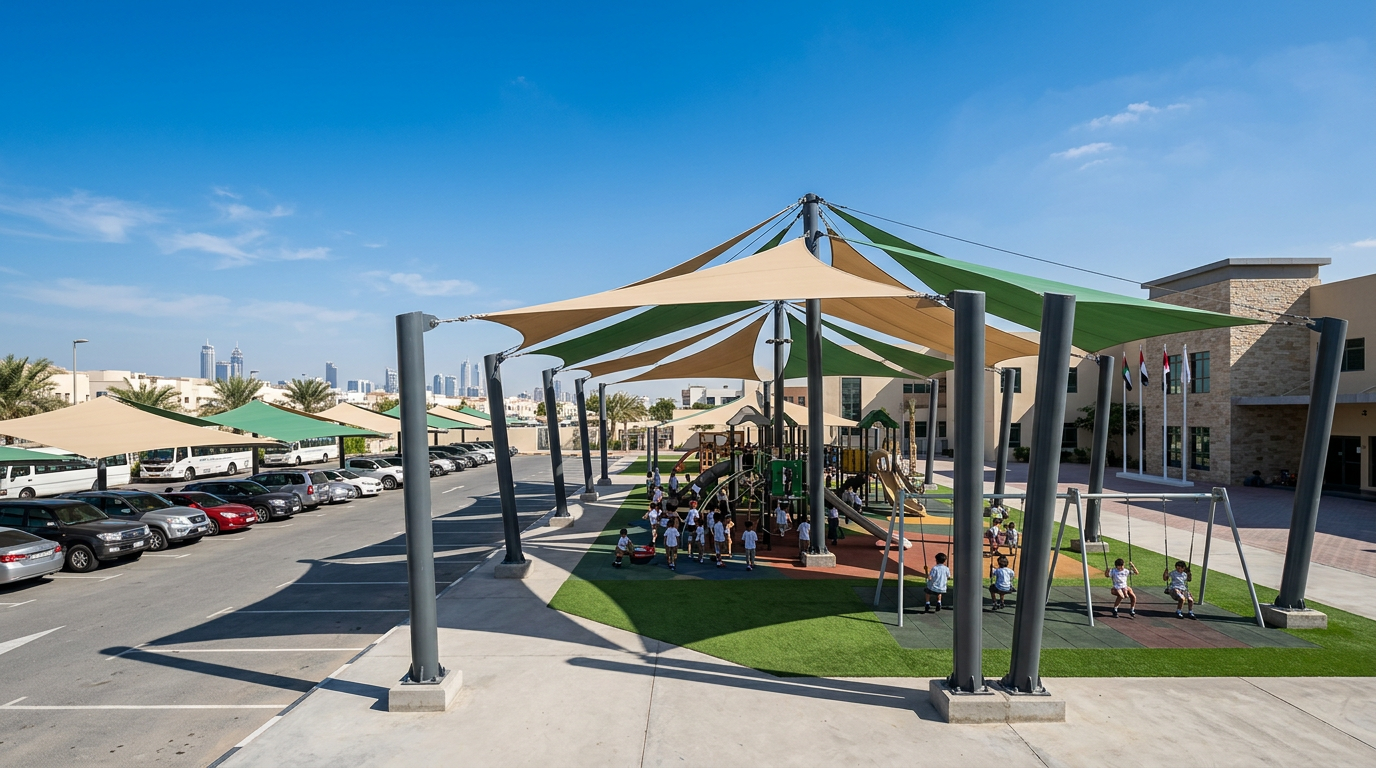
Shade sails can change how an outdoor area works. It can make a car park more comfortable to use, create a protected place for play, or help a courtyard feel more inviting. In Bahrain, effective shade begins with the task the structure must perform and the conditions it must withstand. The fabric is only one part of the design: orientation, supports, foundations, drainage and maintenance all matter.
Choose the right structure for the setting
Shade sails use tensioned fabric connected to support points and can create a light, open look. Tensile fabric structures use a shaped membrane held in tension by an engineered arrangement of supports, cables or frames. A canopy can also be designed as a more conventional supported roof. Terms overlap in everyday use, so ask for a drawing and a clear specification rather than relying on the product name alone.
| Site | What the shade plan should address | Useful design questions |
|---|---|---|
| Car park | Vehicle coverage, turning clearance and access | Which bays need shade, and how will supports affect movement? |
| School | Arrival, gathering and supervision | Does shade cover the spaces used at the relevant times? |
| Playground | Play equipment, circulation and visibility | Is the canopy designed for the play layout and safe access? |
| Park or public space | Seating, paths and open-space use | How will the shade work with landscaping and maintenance? |
The best layout depends on site geometry, sun path, use patterns and the room available for supports. A sail that looks attractive in a rendering may shade the wrong area at the time people need it most. Ask the designer to show the shadow footprint at times relevant to the site, such as school arrival, lunch breaks, after-school play or peak car park use. A visual check of the proposed support locations can prevent posts from landing in a circulation route or obstructing access. Include the space needed for maintenance vehicles or equipment where the canopy serves a large facility.
Map sun, movement and everyday use
Start with a site plan and observe where shadows fall through the day and across the seasons. Identify the busiest areas, entry points, vehicle paths, play zones, seating and accessible routes. For schools and parks, consult the people who supervise or maintain the space; they can identify where shade would have the greatest practical value.
For car park shade sails, consider bay dimensions, vehicle height, turning space, drainage and safe clearance. For playground canopies, review the equipment arrangement and the need for visibility between play areas. Shade should complement supervision rather than create hidden corners. In a landscaped setting, coordinate posts and foundations with irrigation lines, trees, paths and underground services.
Plan for structure, weather and drainage
Fabric structures are shaped to carry tension through their supports. The overall system therefore needs to be designed for the site, including the supports, connections, foundations and fabric specification. Wind exposure, nearby buildings and local conditions can influence engineering decisions; do not assume a design suitable in one location can simply be copied to another.
Ask who is responsible for structural design and which local approvals or reviews are required for the project. Confirm that drawings specify the materials and connection details, and that the foundation arrangement reflects site conditions. A professional assessment is particularly important for large spans, public use, exposed sites or structures near buildings and vehicle routes.
Rainwater management deserves attention even where rainfall is not frequent. The shape and tension of the membrane affect where water flows. Specify how runoff will be directed so it does not create nuisance, erosion, ponding or slippery access areas. The supporting layout should also allow inspection of fixings and fabric.
Select fabric and coverage for the job
Compare the proposed fabric by its documented properties and intended application, not colour alone. Ask about UV resistance, durability, cleaning, fire-related requirements where applicable, warranty conditions, replacement availability and how the fabric is tensioned. For a school or public setting, confirm that the specification and installation meet the project's relevant requirements.
Coverage is also a design choice. The sail's shape, height and orientation affect the area shaded and how open the space feels. A taller structure may maintain circulation but cast a different shadow; a lower edge may cover a particular zone yet constrain movement. Request a plan showing expected coverage at key times, then check it against the site's actual uses.
A successful shade structure does not need to cover every square metre. Prioritise the areas with the clearest need, and coordinate shade with trees, seating and other landscape features. This can create useful sheltered pockets without making the space feel closed in.
Make inspection and maintenance straightforward
Dust, wind and daily use can affect both fabric and fittings. Include access for inspection and cleaning, and agree how often the structure should be checked under the manufacturer's or engineer's guidance. Look for changes in tension, loose or corroded connections, fraying, tears, standing water, damaged supports and signs that foundations have moved.
Do not climb or attempt to re-tension a large sail without suitable training and equipment. Ask the installer for care instructions, approved cleaning methods and an inspection schedule. Clarify who to contact if a storm, impact or visible defect occurs. Maintenance should address the whole structure, not only the canopy fabric.
Shade project checklist
- Map the users, activities, access and desired shade at different times.
- Check support locations against vehicles, paths, equipment, trees and services.
- Request a site-specific structural design and clear drawings.
- Confirm the required reviews or approvals with the responsible local authority.
- Specify fabric performance, connections, drainage and maintenance access.
- Agree inspection, cleaning, repair and post-weather-event responsibilities.
Shade should be comfortable to use and sensible to maintain. Contact GFSS to discuss shade sails and tensile fabric structures for car parks, schools, playgrounds and parks. GFSS has 45+ years of experience and holds ISO 9001, ISO 14001 and ISO 45001 certifications.
Frequently Asked Questions
Are shade sails suitable for Bahrain's climate?
They may be appropriate when designed for the site and intended use. Selection should consider sun coverage, wind exposure, supports, foundations, drainage and the fabric's documented properties.
What is the difference between a shade sail and a tensile fabric structure?
A shade sail is commonly a tensioned fabric canopy supported at selected points. Tensile fabric structures may use more complex shapes, frames, cables and engineered support arrangements. Ask for the actual design and structural details because terminology varies.
What should be considered for a school playground canopy?
Review the play layout, shade coverage, supervision, circulation, equipment access, support locations, drainage and the project's applicable safety and approval requirements. The canopy should be coordinated with the full site plan.
How often should a shade structure be inspected?
Follow the installer's and responsible engineer's guidance, and inspect after any event or visible change that could affect the structure. Frequency depends on design, exposure, use and materials.
Have a project in mind?
Our team is ready to help with landscaping, fencing, irrigation, and specialized surfacing across the Kingdom of Bahrain.
Contact Us