
A fence is not simply a boundary line. It controls access, shapes the public face of a property and has to suit the way people, vehicles and equipment move through the site. The right choice for a private villa may be wrong for a school, warehouse, compound or government facility. Start with the job the fence must do, then compare visibility, appearance, access and upkeep.
When shortlisting a fencing company in Bahrain, ask which complete system meets the site's security, design and operating needs. A fence, posts, gates and installation details all matter.
1. Define the site's needs before comparing products
Write down the boundary's purpose and who will use it. Is the priority to mark a perimeter, discourage climbing, protect equipment, guide pedestrians, preserve a clear view, or complement an entrance? Consider adjoining roads, neighbouring properties, public access, service routes and emergency access. The design and specification should follow the site assessment and the approving authority's requirements.
A useful first brief includes:
- The boundary length, ground levels, corners and existing structures.
- The required height, security objective and acceptable level of visibility.
- Vehicle and pedestrian entrances, including delivery and emergency access.
- Exposure to weather, dust, irrigation water and coastal conditions.
- Appearance, colour, maintenance access and any project-specific requirements.
Ask for a measured site review rather than choosing only from a product photograph. A weak gate arrangement or poorly planned corner can undermine an otherwise suitable fence.
2. Compare common fence types
| Fence type | Often considered for | Main design question |
|---|---|---|
| Chain link | Broad perimeters and utility boundaries | Is visibility or a straightforward boundary the priority? |
| Weldmesh | Schools, compounds and commercial sites | What mesh aperture, panel format and finish fit the brief? |
| Palisade | Perimeters where a more imposing barrier is wanted | What profile, spacing and top detail are permitted? |
| Ornamental | Villas, public-facing or landscaped boundaries | How should security balance with appearance and sightlines? |
| High-security fence | Sites with a defined elevated security requirement | What complete engineered system and access control are specified? |
These are starting points, not performance ratings. Product dimensions, materials, coatings, supports and installation determine the finished result.
Chain link: practical, open boundary
Chain link is a familiar choice where a continuous, relatively open boundary is useful. Its mesh allows sight through the fence and the fence can follow site lines, but the exact product, tensioning, support arrangement and top detail should be selected for the security purpose. It may suit service areas or long perimeters where appearance is secondary. Do not assume one mesh specification fits all sites.
Weldmesh: orderly panel appearance
Weldmesh uses a regular welded grid and is commonly considered where a neat, consistent panel line is desirable. Panel format and aperture affect appearance and the way the boundary behaves; coordinate them with the site layout, gates and ground conditions. It can be a good option for schools, compounds or commercial facilities where a tidy perimeter and clear boundary definition are important.
Palisade: a more assertive perimeter
A palisade fence has vertical steel pales and reads as a more substantial security boundary. It is worth considering for service yards, storage areas and other locations where deterrence is central. Agree the profile, spacing, height and top treatment against the project brief and local requirements. A palisade fence is not automatically the right answer: the site may need visibility, a softer appearance or a different security design.
Ornamental: security with a considered frontage
Ornamental fencing can make an entrance or public-facing perimeter feel more integrated with architecture and landscaping. It is often a sensible starting point for villas, community facilities and landscaped sites when appearance matters alongside enclosure. Discuss spacing, height, finish and the gate design together, so decorative elements do not compromise the stated security objective.
High-security options: specify the full system
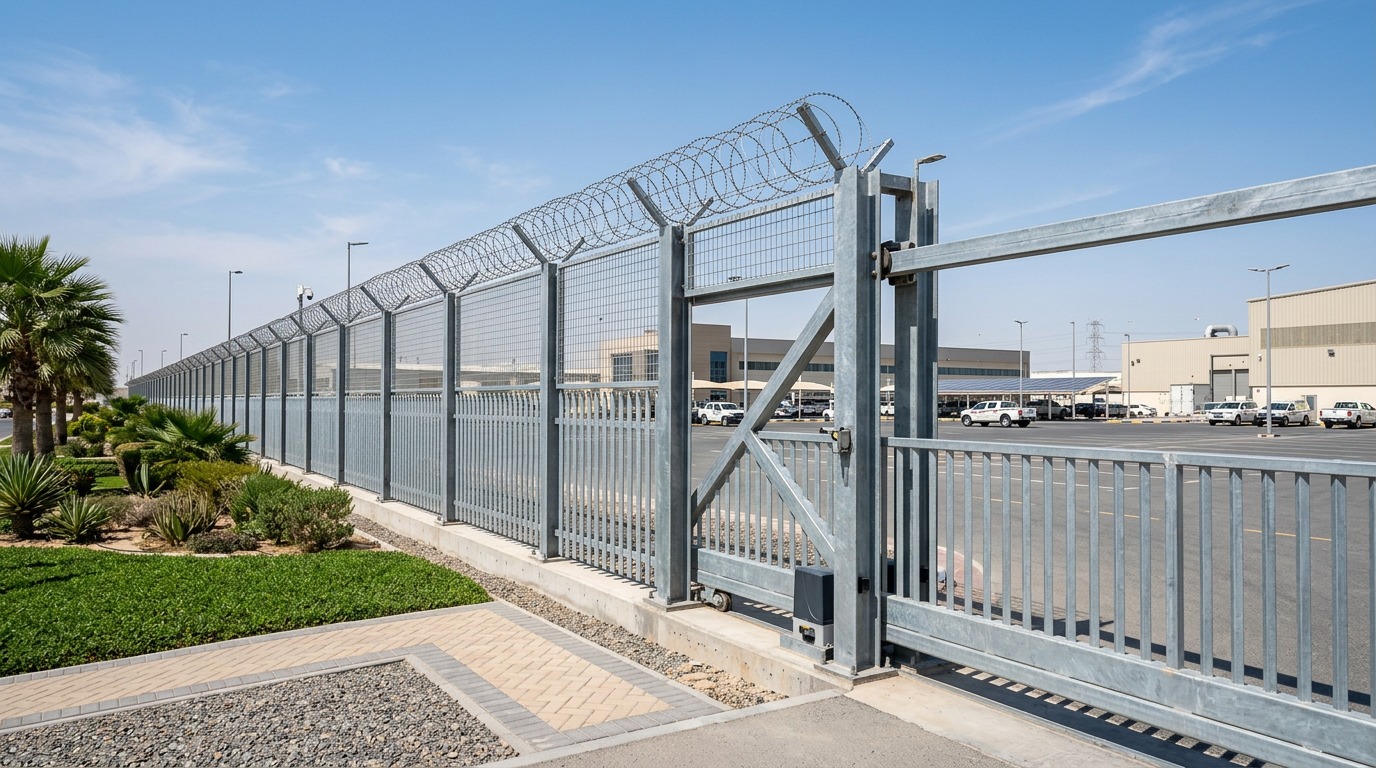
“High security” should describe a defined site requirement, not a label assumed to guarantee a result. GFSS's production range includes high-security fences and gates, climber fence, concertina products, wall spikes and related components. The right combination depends on a risk assessment, approved drawings, compatible access arrangements and local approvals. Ask the contractor to identify what is included and what must be provided by others.
3. Choose the gate as carefully as the fence
The opening is often the most frequently used part of a perimeter. Consider how many movements occur, the vehicles' turning paths, pedestrian separation, opening direction, power or manual operation, access control, delivery queues and maintenance access. A sliding gate can be considered where a swing arc would interfere with circulation, but it needs a clear run and a suitable operating arrangement. GFSS's range includes single and double-leaf gates and sliding gates.
Coordinate gates with the fence specification: posts, track or hinges, foundations, locking, controls and finishes should be compatible. Include safe pedestrian access and an agreed process for emergency entry. On a busy site, the best gate is the one that supports safe, predictable operation day after day.
4. Account for Bahrain's exposure conditions
Bahrain's hot, humid climate, dust and coastal salinity make finish selection and maintenance worth discussing at the design stage. For steel near the coast, do not treat “galvanised” as a universal service-life promise. Coastal corrosion guidance notes that wind direction, temperature, distance from the sea and whether a surface is sheltered can all affect hot-dip galvanised steel performance. It recommends evaluating the project's microenvironment rather than applying a generic life estimate.
Ask what metal protection is specified, how cut edges and joints are handled, whether an additional coating is appropriate, how dissimilar metals are isolated and what inspection or cleaning is recommended. The answer should be specific to the site and product. No coating removes the need for suitable detailing and maintenance.
5. Ask how the product is made and checked
In-house production can give a buyer a clearer route for custom dimensions, material processing and coordination between the fence and gate. It can also make questions about fabrication and quality checks easier to resolve with the supplier. It does not, by itself, prove a lead time or guarantee a result. Confirm the current production schedule, approved drawings, material specification and inspection records for the actual order.
GFSS describes its production service as in-house custom fabrication, material processing, quality control and testing, and supply chain management. For a purchaser, useful questions include:
- Which components are fabricated in-house, and which are sourced externally?
- What drawings and dimensions must be approved before fabrication?
- What checks are recorded for material, welds, finish and assembly?
- How are changes, delivery sequencing and site measurements managed?
- What is the proposed inspection, handover and maintenance process?
6. Compare complete proposals, not fence names
When comparing quotations, check that each one covers the same fence type, height, finish, posts, foundations, gates, hardware, installation, removal or tie-ins, access coordination and close-out information. Ask for exclusions and assumptions in writing. A low headline price is difficult to compare if one proposal omits gate controls or site preparation.
For villas, appearance and a practical entrance may lead the brief. For a school or compound, consider supervised access and pedestrian flow. Developers and facility managers may prioritise repeatable specifications and handover records. Warehouse or industrial operators should coordinate the perimeter with deliveries, loading areas and emergency routes.
Plan your perimeter with GFSS
GFSS supplies and installs security fencing, crash barriers and pedestrian fences, and its production range includes chain link, weldmesh, palisade, ornamental fencing and gates. For a practical consultation, share the site plan, boundary purpose, access needs and any project specification so the options can be considered against the job. Contact GFSS through its contact page.
Frequently Asked Questions
Which security fence is best for a villa in Bahrain?
There is no single best type. Ornamental fencing can suit a visible frontage, while chain link or weldmesh may suit less prominent boundaries. Match the choice to the security brief, architecture, gates and site conditions.
Is palisade fencing more secure than weldmesh?
The names alone do not establish performance. Height, profile, spacing, materials, installation and access control all affect the completed system. Specify the required outcome and compare the full designs.
Should I choose a sliding gate or a double-leaf gate?
Compare available space, vehicle turning, opening frequency and operating arrangements. A sliding gate needs clear space alongside its opening; double-leaf gates need space for the leaves to swing.
Does galvanising make a fence maintenance-free near the coast?
No. Coastal performance depends on site exposure and detailing. Ask for a project-specific finish recommendation and inspection plan rather than relying on a generic lifespan claim.
References
Have a project in mind?
Our team is ready to help with landscaping, fencing, irrigation, and specialized surfacing across the Kingdom of Bahrain.
Contact Us