

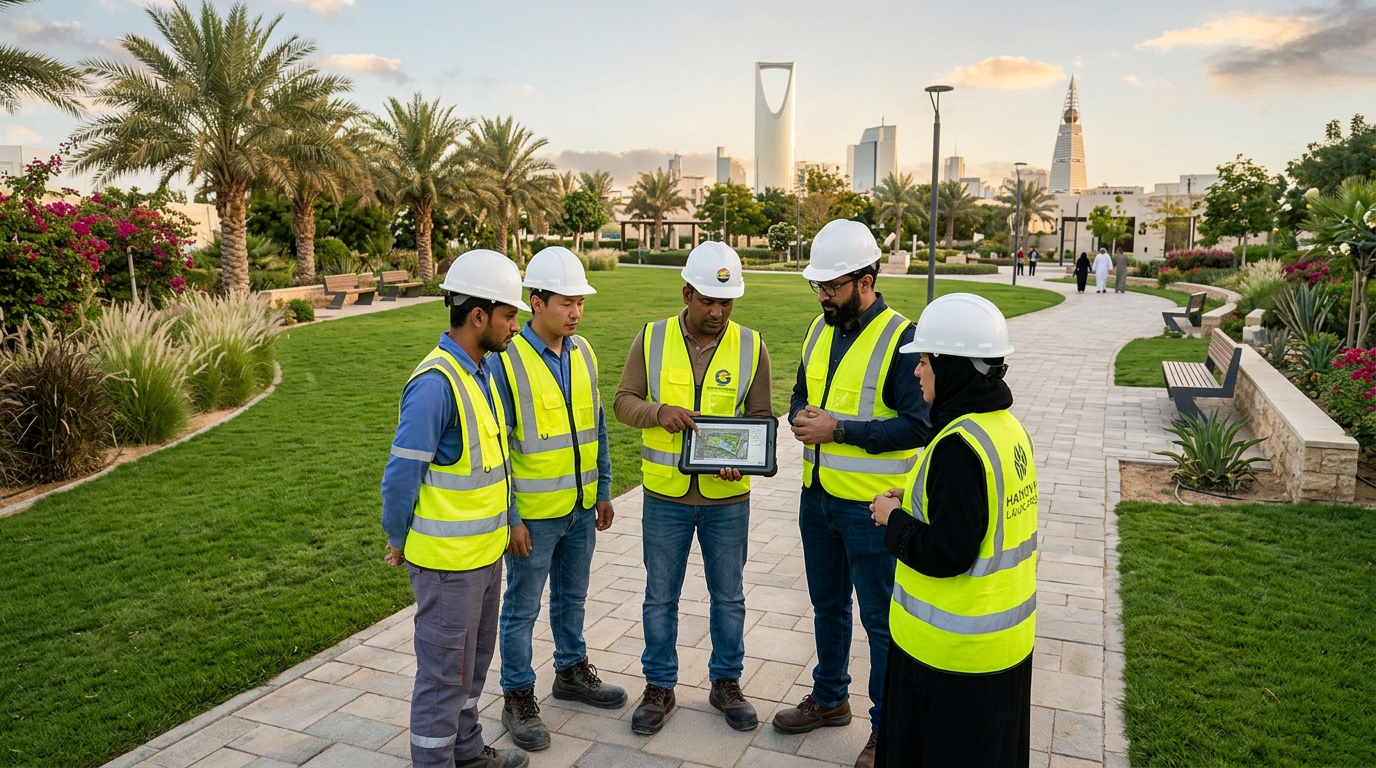
A landscape or outdoor-works proposal can combine planting, irrigation, paving, fencing, shade, surfacing and construction. Comparing providers on one headline price rarely shows whether the scope is complete. A better approach is to ask the same clear questions, compare the written answers and check that responsibility for design, interfaces, delivery and maintenance is understood.
For villa owners, facilities teams, schools, developers and public-sector procurement, the best landscaping contractor in Bahrain is one whose proposal fits the site and can be evaluated against the project brief. Use these questions before appointment.
1. What exactly is included in the scope?
Ask for a scope that separates design, supply, installation, testing, commissioning, protection and handover. Identify the exact areas, quantities, products, finishes and exclusions. For a broad outdoor project, specify whether the contractor is covering landscaping, irrigation, fencing, surfacing, shade or construction, and what another party must deliver.
A clear scope prevents assumptions such as one party expecting another to provide foundations, power, water connections, access or disposal. Ask the contractor to mark its responsibilities on the drawings or scope schedule.
2. Who manages interfaces between the trades?
Outdoor works often meet buildings, roads, drainage, electrical services, irrigation and existing landscapes. Ask who coordinates levels, sleeves, foundations, service routes, access and protection of completed work. Where a project uses several specialist teams, name the interface owner and the process for resolving clashes before they delay installation.
A single-source delivery approach can simplify coordination when one contractor genuinely has the relevant capabilities and a clear scope. It is not automatically superior in every project: verify which trades the contractor will perform, which it will subcontract and who remains accountable for each interface.
3. What relevant experience can you document?
Ask for examples that are relevant to the project type, scale and operating environment. Look for the work category, the contractor's role and the scope delivered, rather than relying only on a logo or project name. Ask for references where they are available and appropriate, and confirm the details through the procurement process.
GFSS states that it is Bahrain-based and established in 1979, with 45+ years of experience. Its public portfolio includes landscaping and irrigation maintenance at Bahrain International Airport, Ministry of Education landscaping and nursery work in Isa Town, shade structures, fencing, sports surfacing and other construction categories. These are experience examples, not a promise that a proposed project will have identical conditions or outcomes. Ask which specific experience is relevant to your scope.
4. What do your ISO certificates cover?
Ask to see current certificates and verify the entity, scope, locations, issue and expiry dates, and certification body. A certificate's presence is not a substitute for reviewing the project team, programme, technical submittals or site controls.
For context, the ISO standard names refer to management-system subjects: ISO 9001 concerns quality management, ISO 14001 environmental management, and ISO 45001 occupational health and safety management. In practical terms, ask how the certified systems translate into project controls: quality checks and corrective actions; management of relevant environmental impacts; and planning for worker health and safety. Confirm that the certificate scope applies to the contracting entity and work being procured.
GFSS lists ISO 9001, ISO 14001 and ISO 45001 certifications. During due diligence, request the current certificates and check their scope and validity rather than treating a certification statement as a substitute for project-specific evidence.
5. How do you select materials for Bahrain conditions?
Ask how the proposed materials suit heat, humidity, dust, irrigation water and, where relevant, coastal salinity. Request manufacturers' technical data, installation requirements, cleaning instructions and limitations. For metals, coatings and outdoor finishes, ask what exposure assumptions were used and what inspections or maintenance are recommended.
A responsible proposal should avoid unsupported lifespan guarantees. It should explain the selected products, site assumptions and routine care required, and identify any conditions that might change the recommendation.
6. How will you control programme and changes?
Ask for a sequence of work, dependencies, site access needs, long-lead items and decision dates. Confirm what the contractor needs from the client before it can proceed, including approvals, permits, site access and utility information. Agree how changes are documented, priced and approved before work is altered.
“On time” and “within budget” are meaningful only against an agreed scope, programme and change process. Ask for progress updates and a clear route for raising risks early, particularly when works must coexist with an operating school, compound, facility or public area.
7. What quality checks and approvals are planned?
Request the inspection and test plan, material-submittal process, sample approvals and acceptance criteria. Establish which work is inspected before it is covered or handed over, and who signs off. For surfacing, fencing and irrigation, ask what is checked at installation and commissioning, and what records will be provided.
If a project specification or authority approval governs the work, identify it in the contract documents. Do not rely on a verbal assurance that the installation will “meet all standards” without naming the applicable specification and how compliance will be demonstrated.
8. What will the maintenance contract include?
A landscape maintenance contract should define the included areas, visit frequency, seasonal tasks, response process and reporting. List the work covered for planting, irrigation, lawn or artificial grass, hard surfaces and any associated assets. State how replacement plants, consumables, repairs, water use, waste removal and extra work are treated.
Ask how routine inspections are recorded, how faults are prioritised, what is excluded and how additional work is approved. Agree key contacts, access arrangements, service hours and a process for reviewing the contract if site needs change. Avoid vague phrases such as “full maintenance” without a task schedule.
9. What does project handover look like?
Handover should leave the client able to operate and maintain the completed work. Ask for as-built drawings where applicable, product data, warranties or supplier documents, test and commissioning records, maintenance schedules, training, keys or access details and a list of outstanding items. Agree what counts as completion and who clears each outstanding item.
For planting and irrigation, ensure the handover explains the installed system and its routine care. For fencing, surfacing or shade structures, obtain relevant product and inspection information. The handover content should reflect the work actually included.
10. What is excluded, and who owns the risk at each boundary?
Before signing, review exclusions, provisional sums, assumptions, access, utilities, permits, traffic management, protection, disposal and interfaces with other contractors. Ask what happens if concealed conditions differ from the survey or if an approval changes the design. Ensure the contract identifies the decision-maker for variations and the evidence needed to agree them.
| Compare before appointment | A clear proposal should state |
|---|---|
| Scope | Areas, quantities, inclusions and exclusions |
| Delivery | Programme, dependencies, access and change control |
| Quality | Submittals, checks, acceptance criteria and records |
| Maintenance | Tasks, frequency, response and excluded work |
| Handover | Drawings, documents, training and open items |
Make the appointment with clarity
GFSS works across landscaping, irrigation, fencing, surfacing, shade structures and construction, as well as maintenance. A useful first conversation is grounded in your drawings, project priorities, operating conditions and required handover. Contact GFSS for a consultation through its contact page, and use the questions above to shape a clear, comparable brief.
Frequently Asked Questions
How do I compare landscaping contractors in Bahrain?
Give each shortlisted contractor the same drawings and scope, then compare inclusions, exclusions, materials, programme, quality checks, maintenance and handover on a like-for-like basis.
What does ISO certification tell me about a contractor?
It identifies a management-system framework in a particular subject area. Check the current certificate's entity, scope and validity, then ask how those systems are applied to your project.
What should a landscape maintenance contract include?
It should define covered areas, tasks, frequency, inspections, reporting, response times or process, exclusions, replacement or repair arrangements and how extra work is approved.
Why is project handover important?
Handover provides the records and instructions needed to operate, inspect and maintain the completed work. Define the required documents and outstanding-item process in the contract.
Have a project in mind?
Our team is ready to help with landscaping, fencing, irrigation, and specialized surfacing across the Kingdom of Bahrain.
Contact Us